You're all caught up—no notifications available.
Explore All Exams at KGS


All Exams
Explore All Exams at KGS

Khan Sir Courses
Geography I Polity I History | World Map I Indian Map I Economics I Biology

UPSC & State PSC
UPSC I BPSC I UP-PSC I MP-PSC

State Exams
UP I Bihar I MP | Rajasthan

NEET | JEE | CUET | Boards
NEET | JEE | CUET | Boards

Defence Exams
NDA I CDS I CAPF I AFCAT I SSB I Agniveer

Police Exams
UP SI | Bihar SI | Delhi Police | UP Constable

SSC Exams
CGL I CPO I CHSL I MTS I SSC GD I Delhi Police

Foundation Courses
Physics I Chemistry I Biology I History I Geography I Polity I NCERT I Math I English | Map I Reasoning

Railway Exams
RRB | RPF

Teaching Exams
TET | Teaching | UGC

Banking Exams
SBI | RBI | IBPS

Engineering Exams
Civil | Electrical | Mechanical
UGC NET
UGC NET/JRF
Current Affairs provides you with the best compilation of the Daily Current Affairs taking place across the globe: National, International, Sports, Science and Technology, Banking, Economy, Agreement, Appointments, Ranks, and Report and General Studies

SYLLABUS
GS-3: Issues related to direct and indirect farm subsidies and minimum support prices.
Context: Recently, the Cabinet Committee on Economic Affairs, chaired by the Prime Minister, approved an increase in the Minimum Support Price (MSP) for copra for the 2026 season.
More on the News
• For the 2026 season, MSP has been fixed at ₹12,027 per quintal for Fair Average Quality milling copra and ₹12,500 per quintal for ball copra, reflecting an increase of ₹445 and ₹400 per quintal.
• Since 2014, MSP has risen from ₹5,250 to ₹12,027 for milling copra and from ₹5,500 to ₹12,500 for ball copra, registering growth of 129% and 127%, respectively.
• National Agricultural Cooperative Marketing Federation of India Ltd. (NAFED) and National Cooperative Consumers’ Federation (NCCF) will continue to act as Central Nodal Agencies (CNAs) for the procurement of copra under Price Support Scheme (PSS).
• This move will ensure better returns for coconut growers and encourage increased copra production to meet rising domestic and international demand.
• The increase in MSP is in line with the Government’s announcement in the Union Budget 2018–19 that MSP for all mandated crops would be fixed at a minimum of 1.5 times the all-India weighted average cost of production.
About Copra
• Copra is the dried meat or kernel of the coconut, harvested from the mature fruit of the coconut palm (Cocos nucifera).
• Copra is valued for the coconut oil extracted from it and for the resulting residue, coconut-oil cake, which is used mostly for livestock feed.
• India produces two types of copra: milling copra, used for oil extraction, and ball/edible copra, consumed as a dry fruit or for religious purposes.
• According to the Coconut Development Board (CDB), 45.8% of total coconut production went into copra, 33% milling and 12.8% ball copra in 2022-23.
• As of 2023, India is the world’s third-largest coconut producer (after the Philippines and Indonesia), contributing 31.45% of global output with 21,373.62 million nuts in FY24.
• The crop contributes around Rs. 30,795.6 crore (US$ 3.72 billion) to the country’s gross domestic product (GDP) during FY23.
• In FY 2023-24, Karnataka led coconut production with 6,151 million nuts, followed by Tamil Nadu at 6,092 million and Kerala at 5,522 million.
• World Coconut Day is observed on 2nd September each year, marking the 1969 founding of the International Coconut Community (ICC), an intergovernmental body under the United Nations Economic and Social Commission for Asia and the Pacific( UNESCAP).

MSP Regime of India
• The Minimum Support Price (MSP) is a form of market intervention by the Government to protect agricultural producers against any sharp fall in farm prices.
• MSPs are announced by the Cabinet Committee on Economic Affairs (CCEA) at the beginning of the sowing season for certain crops (currently 23) based on the recommendations of the Commission for Agricultural Costs and Prices (CACP).
• The list of crops is as follows:
Source:
PIB
Coconut Community
Agritech.Tnau
Ibef
PIB
Nafed-India
Nccf-India
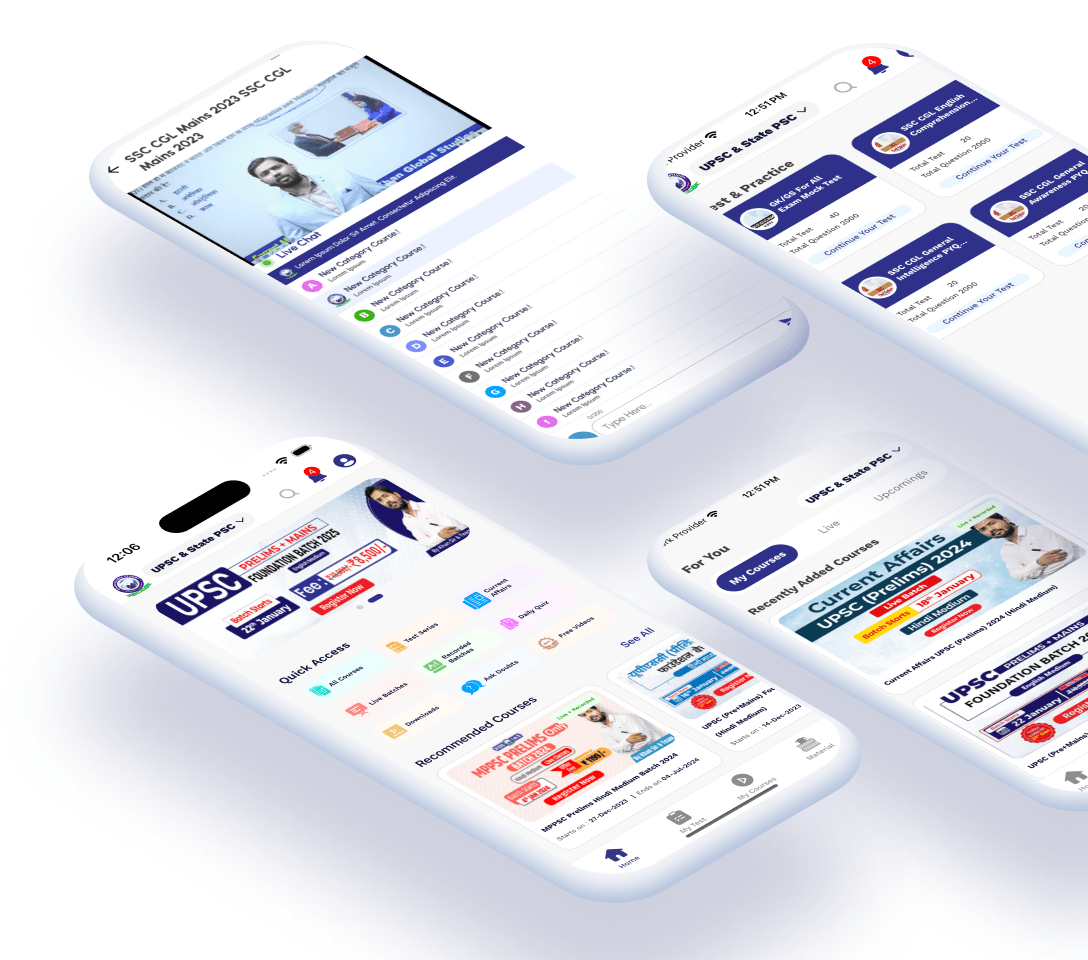
The most trusted learning platform on your phone
With our training programs, learning online can be a very exciting experience! Take the next step toward achieving your professional and personal objectives



NCERT Books
Resources
We love learning. Through our innovative solutions, we encourage ourselves, our teams, and our Students to grow. We welcome and look for diverse perspectives and opinions because they enhance our decisions. We strive to understand the big picture and how we contribute to the company’s objectives. We approach challenges with optimism and harness the power of teamwork to accomplish our goals. These aren’t just pretty words to post on the office wall. This is who we are. It’s how we work. And it’s how we approach every interaction with each other and our Students.
Come with an open mind, hungry to learn, and you’ll experience unmatched personal and professional growth, a world of different backgrounds and perspectives, and the freedom to be you—every day. We strive to build and sustain diverse teams and foster a culture of belonging. Creating an inclusive environment where every students feels welcome, appreciated, and heard gives us something to feel (really) good about.
Get Free academic Counseling & Course Details